








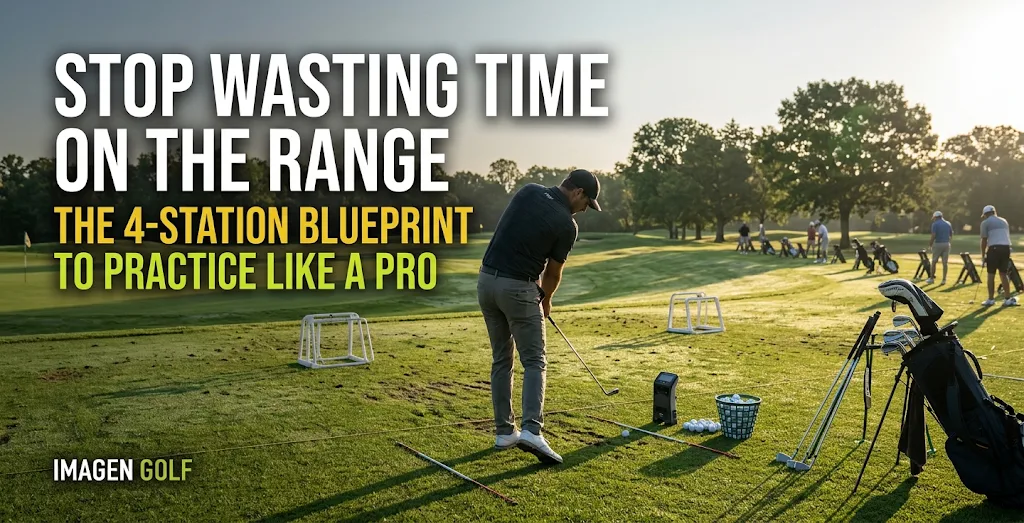
Stop Wasting Time on the Range: The 4-Station Blueprint to Practice Like a Pro
To practice golf like a professional, you must structure your sessions around specific, measurable goals rather than aimlessly hitting balls. A pro-level practice regimen divides time into four distinct stations: Block Practice, Technical Work, Skill Development, and Performance Practice, ensuring every swing has a clear purpose, consequence, and tracked outcome.
How Should I Set Goals for Golf Practice?
Effective golf practice requires setting specific long-term, short-term, process, and outcome goals based on actual tournament statistics. Instead of a vague goal like "practicing chipping," target specific conditions like downhill lies, varying clubs, or uneven terrain to directly lower your scores.
To stop wasting time on the range, you must work smarter, not harder. A "skill within the skill" approach ensures you extract maximum value from your allotted time.
Audit Your Stats: Track fairways, greens in regulation, and putts over a 10-to-20 round baseline. Target long-term areas for improvement rather than reacting emotionally to your most recent round.
Get Granular: Avoid broad statements. If your stats show weakness inside 50 yards, dedicate your session specifically to reading lies, adjusting to sidehill slopes, and varying wedge loft.
Establish a Baseline: Knowing your baseline metrics allows your coach to prescribe the exact drills needed for your game.
What Are the 4 Essential Golf Practice Stations?
Professional golf practice is divided into four structural stations: Block Practice for repetition, Technical Work for swing mechanics, Skill Development for varied shot-making, and Performance Practice for on-course simulation. This balanced framework guarantees both mechanical improvement and scoring execution under pressure.
To properly allocate your time, divide your sessions using this structural matrix:
Practice Station
Core Focus
Rules & Execution
Pro Example
1. Block Practice
Movement Repeatability
Perform the same task from a fixed position to drill mastery.
Holing 100 consecutive 6-foot putts or hitting 100 80-yard wedges to the same green.
2. Technical Work
Swing Mechanics
Ignore ball flight completely. Focus entirely on feeling new movement patterns.
Using mirrors, slow-motion swings, and video analysis with your swing coach.
3. Skill Development
On-Course Transfer
Vary clubs, shot shapes, and targets. Recreate the exact scenarios you face on the course.
Dropping the ball in random lies (rough vs. fairway) and utilizing your full pre-shot routine.
4. Performance Practice
Pressure & Consequence
Make every shot measurable. Build obstacles harder than real golf to stress-test your game.
Missing a pitch means losing points or starting the entire drill over from zero.
The video below demonstrates how professionals structure their drills and manage station rotations on the range.
29:21
How I Practice For a Major
YouTube · Tommy Fleetwood
How Do I Build Mental Toughness During Golf Practice?
You build mental toughness by artificially injecting pressure into your practice sessions and anticipating setbacks. By adding strict consequences to drills, applying rigorous pre-shot routines, and competing against practice partners, you simulate the exact nerves required to break 90, 80, or 70.
Improvement is rarely linear. It usually looks like two steps forward and one step back.
Put Something on the Line: Make 20 putts in a row; if you miss the 19th, you must start over. Watch how your heart rate spikes as you get closer to the goal.
Find a Practice Pal: Practice with a golfer of similar ability and aspiration. Competing against them breeds accountability and forces you to perform under a watchful eye.
Embrace the Ugly: Accept the need for change. Swing overhauls will feel uncomfortable initially, but resilience through setbacks dictates your long-term ceiling.
How Do I Track Golf Practice Progress and Avoid Burnout?
Sustaining progress requires balancing relentless improvement with the maintenance of your natural strengths. You must document key feels, track measurable data after every session, and celebrate small victories to avoid treating practice as a chore and keep your training efficient.
"Swing your swing." You have individual techniques that work for you. Don't strip away your natural advantages in pursuit of a textbook aesthetic. Run through this checklist after every practice session:
Log Your Metrics: Did you record your baseline stats and performance game scores (e.g., beating your personal best up-and-down score by 2)?
Document the "Feels": Write down the specific mechanical thoughts and drills that worked so you can easily access them during your next session.
Allocate Maintenance Time: Dedicate 15-20% of your practice strictly to your strengths so they do not inadvertently degrade into weaknesses.
Frequently Asked Questions (FAQ)
What is block practice in golf? Block practice involves performing a specific task or movement repeatedly from a fixed position, such as hitting 100 consecutive 80-yard wedge shots to the exact same target. It is used to entrain physical movement patterns and build muscle memory.
Should I care about ball flight during technical practice? No. During technical practice, your sole focus must be on movement patterns, exaggerations, and swing mechanics. You should ignore where the ball goes entirely and rely on video analysis, mirrors, or training aids for immediate feedback.
How do I transition practice swings to the golf course? You bridge the gap using Performance Practice. This requires changing targets and clubs for every single shot, strictly adhering to your pre-shot routine, and applying severe scoring consequences to simulate on-course pressure.
Why should I track my golf statistics? Tracking long-term statistics identifies your most costly recurring weaknesses on the course. This prevents you from wasting time on reactionary practice routines based on the emotion of one recent bad round.